IMPACT Network
The Innovative Medicine and Precision Approaches to Clinical Trials (IMPACT) Network is an international collaborative of sites working together to accelerate clinical trial readiness and therapeutic development for autism and related neurodevelopmental conditions.

Why Innovative Medicine and Precision Approaches to Clinical Trials?
What is Known
The autism field has experienced more than a decade of progress in gene discovery and neurobiology; however, therapeutic advancement has not kept the same pace.
Challenges
Barriers to the development of new therapies include a lack of standardized approaches to data collection and analysis, as well as fragmented clinical trial infrastructures.
Opportunity
The IMPACT Network seeks to build a unified infrastructure to capitalize on neurobiological discoveries and standardize clinical research, clinical care, and clinical trials.
Integration
The ARIA initiative promotes a connected environment in which all ARIA components—Research Hubs, Community Collaborators, and Centralized Services—interact to propel scientific discovery.

Research Hubs
Promising discoveries and therapies from the other research hubs will be tested within the IMPACT Network’s core sites.
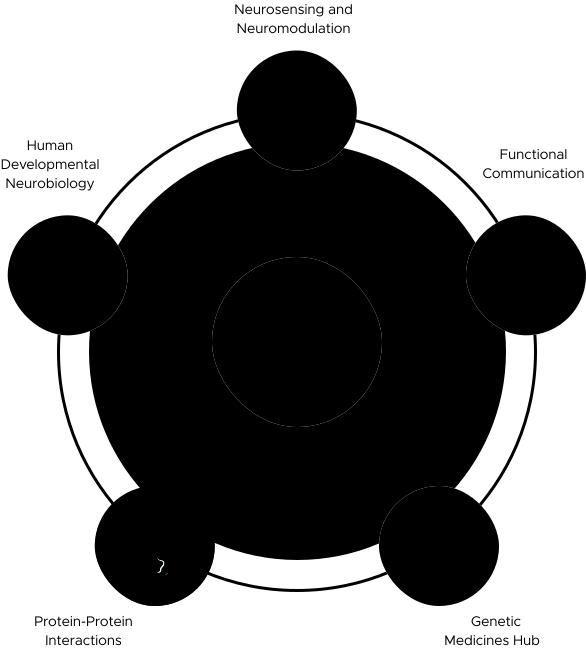

Community Collaborators
Community Collaborators provide their perspectives to support the IMPACT Network and other research hubs.

Centralized Services
Centralized Services provide consistency, scalability, and long-term data interoperability for findings from IMPACT Network Sites.
IMPACT Network Sites
IMPACT Network sites are comprised of collaborative research teams that bring together expertise across disciplines to develop new outcome measures, clinical endpoints, and biomarkers that have the potential to transform clinical care.
Sites will join the network in waves. The following sites have been selected to join the IMPACT Network.
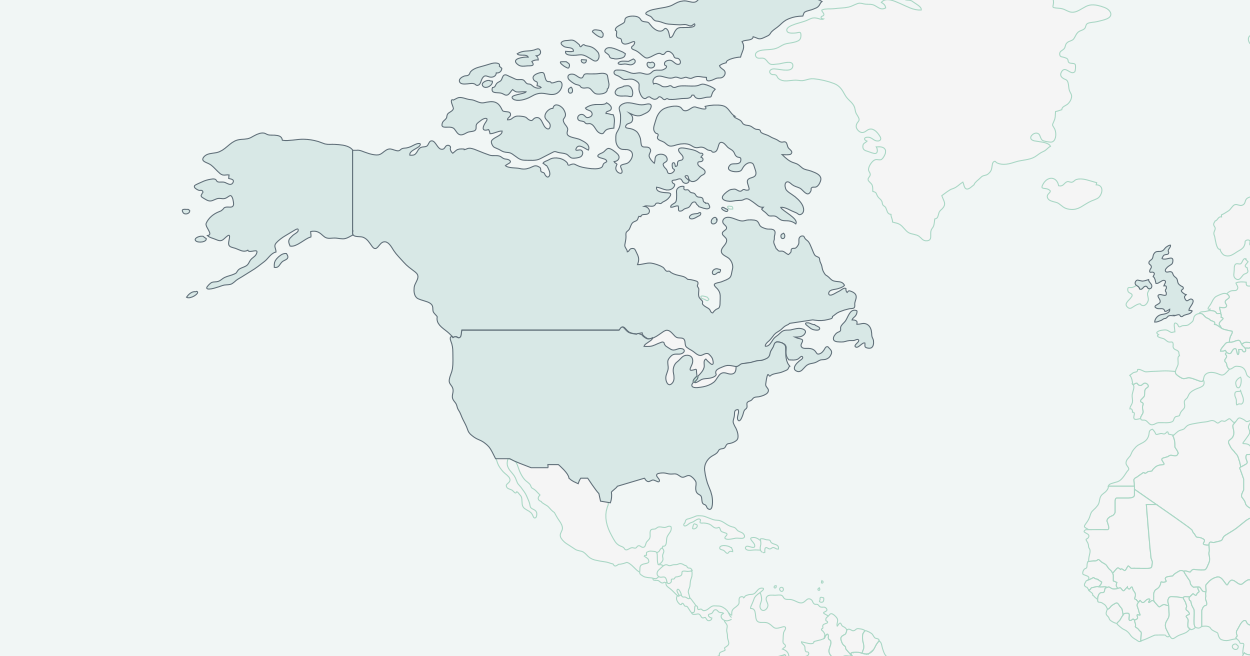
IMPACT Atlanta
- Emory University
- Georgia State University
- Children's Healthcare of Atlanta





IMPACT Boston
- Boston Children's Hospital (BCH)





IMPACT Carolina
- University of North Carolina at Chapel Hill (UNC)




IMPACT Colorado
- University of Colorado Anschutz Medical Campus
- Children's Hospital of Colorado





IMPACT LA
- Children's Hospital Los Angeles (CHLA)
- University of California, Los Angeles (UCLA)




IMPACT New York
- Weill Cornell Medicine
- Columbia University Medical Center
- New York State Psychiatric Institute (NYSPI)




IMPACT Ohio
- Cincinnati Children's Hospital Medical Center (CCHMC)





IMPACT Philly
- Children's Hospital of Philadelphia (CHOP)
- University of Pennsylvania





IMPACT Seattle
- Seattle Children's Hospital
- University of Washington





IMPACT Texas
- Baylor College of Medicine (BCM)
- Texas Children's Hospital




IMPACT Toronto
- Holland Bloorview Kids Rehabilitation Hospital (Holland Bloorview)
- Hospital for Sick Children (SickKids)





IMPACT UK
- University of Oxford
- King's College London (KCL)




IMPACT Baltimore
- Kennedy Krieger Institute
Wave 2
Researchers
Coming soon!
IMPACT Chicago
- Rush University & University of Oklahoma
Wave 2
Researchers
Coming soon!
IMPACT Kansas City
- University of Kansas
- Children’s Mercy Hospital
Wave 2
Researchers
Coming soon!
IMPACT Minnesota
- University of Minnesota
Wave 2
Researchers
Coming soon!
IMPACT New Haven
- Yale University
Wave 2
Researchers
Coming soon!
IMPACT St. Louis
- Washington University in St. Louis
Wave 2
Researchers
Coming soon!
IMPACT San Francisco
- University of California, San Francisco
Wave 2
Researchers
Coming soon!
IMPACT Stanford
- Stanford University
Wave 2
Researchers
Coming soon!
ARIA IMPACT-Ready Study
Selected sites will implement the ARIA IMPACT-Ready Study, a short-term natural history and clinical endpoint study that follows participants over time to build a deeper understanding of how autism and related neurodevelopmental conditions develop and change over time. The insights generated will lay the groundwork for the next generation of clinical trials.
The study enrolls participants across two cohorts, designed to ensure that both children and young adults with a known genetic cause for their autism and those without an identified genetic cause have a pathway to participate.
Cohort 1
This group focuses on children and young adults (birth to 18 years) with genetic changes known to cause or contribute to autism who will be followed over time. This initially includes children and young adults with genetic variants (classified as pathogenic or likely pathogenic) in one of five genes strongly linked to autism (ARID1B, GRIN2B, RNU4-2, SCN2A, and SLC6A1). Importantly, children qualify for this cohort based purely on their genetic variant; a formal diagnosis of profound autism is not required to participate.
Cohort 2
This group focuses on autistic children and young adults (ages 2 to 18 years) who have likely profound or profound autism, as defined by using few or no words to communicate, needing substantial and consistent support (often 24/7), and who do not have a definitive genetic cause for their profound autism at the time of enrollment. This cohort was created specifically to include autistic children and young adults with significant communication challenges and who have intensive support needs—individuals who have too often been left out of research. Whole-genome sequencing will be performed as part of the study, and if a definite genetic cause for autism cannot be identified, this cohort will be followed over time (Cohort 2a).
After whole-genome sequencing, some children and young adults may be found to either have a genetic variant known to cause or contribute to autism that is not within the genes of focus in Cohort 1, or they may not meet the study definition of profound autism. Meaningful genetic, clinical, and biomarker data will be collected from these participants at the baseline visit, but this cohort (Cohort 2b) will not be followed over time.
Study Timeline
The study will operate for 5 years, and individual participants will complete 1-5 in-clinic visits (up to ~2 years).
Gene Selection Framework
The genes included in Cohort 1 were selected as a starting point, with the eventual goal to broaden inclusion over time as the IMPACT Network evolves. These genes were selected based on a framework that prioritized genes with strong evidence of association with autism, an understood genotype–phenotype relationship, and features that could be measured in clinical trials. Genes were also selected to ensure sufficient patient numbers with established patient advocacy groups and to address a need for “trial-ready” multidimensional longitudinal natural history data that bridges caregiver reports with in-clinic assessments, quantitative phenotyping, and biomarker analyses. By focusing on genetic conditions that need these “trial-ready” natural history data, the IMPACT-Ready Study can establish the baseline infrastructure needed to scale research for these underserved populations, creating a foundation that can be extended to many more genetic conditions over time.
A Rising Tide Lifts All Boats
Every family who participates—in any cohort—is contributing to something larger than any single condition. By deeply studying the initial genes in Cohort 1, we are uncovering shared biological pathways and perfecting measurement tools that can be applied across the entire autism spectrum. A discovery for one condition creates a wave of progress that accelerates answers, clinical readiness, and targeted support for everyone.
Enrollment within the study will occur in multiple waves. Additional information will be made available.
Those interested in learning more are encouraged to visit our FAQ page.


